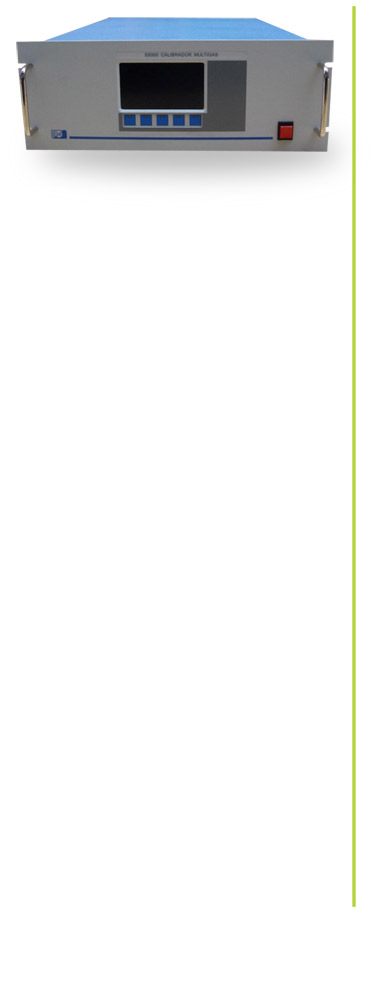
The SIR Model S-5006 is a Non-Dispersive Infrared (NDIR) Analyzer for the measurement of Carbon Monoxide concentrations in ambient air. Being a photometric device, it operates on the principle that the pollutant CO absorbs light at specific wavelengths and will decrease the intensity of a probing light beam in non-linear proportion to its concentration. the primary device that determines the specificity of an analyzer to the pollutant it must measure. The model S-5006 employs the technique of Gas Filter Correlation (GFC). In this technique, a highly specific light probe is created by causing a beam of infrared fight of narrow spectral bandwidth to be intercepted by a rotating wheel containing two different entrapped gases: carbon monoxide and nitrogen.
When the light beam is intercepted by the carbon monoxide portion of the wheel, the carbon monoxide, which is at relatively high concentration, absorbs all wavelengths that are co-specific, creating and emanating light beam that is "CO blind". This "optically scrubbed" portion of the beam is designated the Reference beam, as compared to the nitrogen-intercepted portion of the beam, which is "CO sensitive", and therefore is designated the Measure beam. The single, time-shared Reference (R) and Measure (M) beam is reflected many times back and forth across the photometer chamber where more of its light energy is absorbed by sampled Gaseous CO with each traversal. In the absence of CO no attenuation of the R and M portion of the beam will occur species other than CO will cause an equal attenuation of both R and M portions of the beam. If CO is present in the air being sampled, then the beam portion generated by the CO side of the wheel will experience no attenuation, but the beam portion generated by the N2 portion of the wheel will be attenuated to the degree dictated by the level of CO concentration.
A third portion of the time-shared beam is also produced. This is the "dark portion", which is simply the period of time in the rotation of the GFC wheel in which the light beam is totally blocked off or "dark". This provides a zero light reference point to compensate for the "dark current" of the detector.
The rotation of the motor shaft determines the timing of the optical events taking place in the optical bench. In order for the Measurement information to be synchronously decoded by the electronic system, the latter must be coordinated time-wise with the wheel rotation.
MODEL S-5006 NDIR GFC CO Analyzer