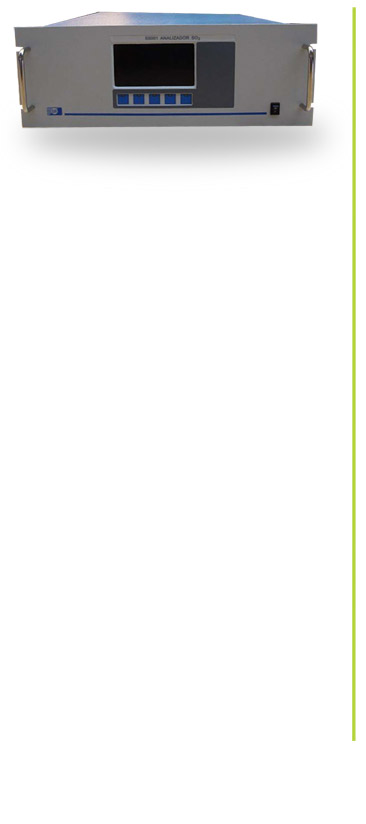
SIR Model S-5001 is a Non-Pulsed U.V. Fluorescence Sulfur Dioxide Analyzer. In the nalyzer, optically filtered pure monochromatic U.V. light from a Zinc lamp is focused onto the SO2 reaction chamber. This beam is of invisible U.V. light and is termed the excitation beam or sometimes the "primary beam". The intensity of the beam is directly viewed by the primary beam intensity measuring detector (control detector). The same beam is viewed at right angles by a wavelength selective photomultiplier (PM) detector which is tuned by an optical discrimination filter to reject the primary beam diation, but to be sensitive to radiation in a discrete portion of the visible spectrum. SO2 molecules intercepting the primary beam are U.V. energized through primary beam light absorption.
These excited molecules "de-energize.' themselves by re-emitting light at a higher wavelength (lower energy). The re-emitted light is given off in all directions, and a portion of it, the secondary beam, is viewed through the primary beam "blocking" filter by the photomultiplier detector. Model S-5001 uses non-pulsed U.V. radiation, which effectively doubles the detected signal as compared to a chopped light instrument, thereby significantly increasing the signal-to-noise ratio. The usual task of correcting for PM and control detector dark current normally performed by light pulsing is achieved by a microprocessor controlled shutter system which periodically and momentarily blocks the primary beam. This blocking is done over a short time interval relative to the non-blocked time.
All functions of Model S-5001 are under microprocessor control, and the SO2 concentration is obtained by microprocessor computation of stored averaged values that contain information relative to the detector dark currents, scattered light values, total fluorescence signal, and lamp intensity. By making use of a sophisticated microprocessor program, the normal zero drift inherent to most SO2 monitors is factored out by DYNAMIC ZERO STABILIZATION (DZS), a technique which correlates background radiation to source intensity changes and corrects for them by a microprocessor ratioing technique. Similarly, span drift is made virtually non-existent through the monitoring of source intensity and the use of the DZS technique resulting in an instrument of remarkable stability.