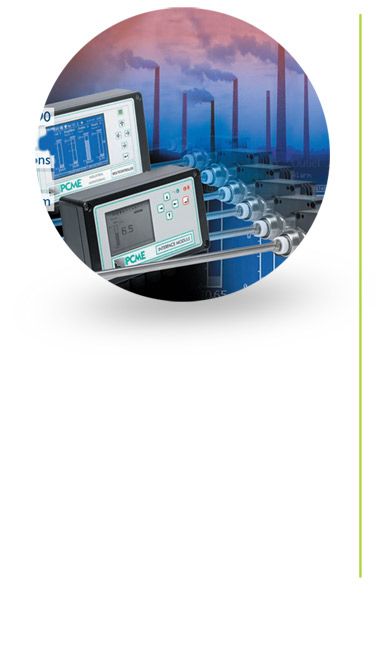
Principle of Operation. The DT990 combines advanced signal processing techniques with PCME's unique Electrodynamic measurement principal. When the sensing probe is installed in the duct or stack, particles in the airstream interact with the sensing rod and a charge induction effect is analysed in the probe. Distributions in the particle stream result in a frequency charge induction response, which is directly proportional to the concentration of particulate (application dependant). The instrument's output is an analysis of this frequency response and can be calibrated in mg/m3 by comparison to reference iso-kinetic sample results. This technique has acheived ISO 10155, MCERTS & TUV approval.
Advanced design. Unlike Triboelectric systems, the Electrodynamic measurement is not signifi cantly affected by velocity variations between 8m/s and 20m/s and is not affected by build up on the rod surface. The DT990 is, therefore, suitable for emission measurement in the most aggressive environments including those stacks with variable velocity. In addition, PCME's Electrodynamic technique enables the use of patented fully insulated probes, essential for high humidity gas streams and applications with high conductive dust loadings. Very low concentrations (<0.01rng/m3) can be measured due to this unique measurement principal. Automatic gain controls allow the system to optimise its response to varying dust levels e.g. pulsing bagfilters.
Features include:
- Normalisation for T and 02*
- Broken Bag diagnostics for pulse cleaned Bagfilters
- Assumes input from appropriate monitor
- Mass calculation (kg/year) capability for both fixed and varying velocity applications (varying velocity requires velocity input)
DT990

T: OFFICE : +27(0) 16 341 5950
F: +27(0) 86 675 6830