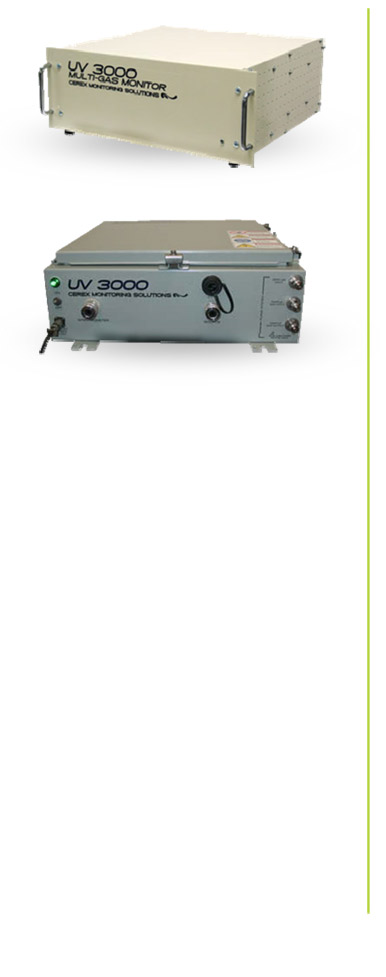
The Cerex UV3000 is a multifunction analyzer designed to detect part per billion (ppb) to percent level concentrations of multiple gases within a mixture. The UV3000 measures gas concentrations utilizing light absorption from a long path beam of UV radiation coupled to a variety of external sample cells and probes. A broadband miniature spectrometer collects the gas fingerprint data and the advanced software compares the results to a calirated reference, or 'library spectra". Ultraviolet spectroscopy principles are similar to common infrared methods, but offer lower detection capability for many chemicals associated with impact on Human Health. An onboard or external PC reports reliable real time concentration data up to once per second and stores all spectral data for later post processing or archiving.
Common applications for the UV3000 include measuring Ammonia (NH3), Chlorine (CL2), Sulfur Dioxide (502), and BTEX amongst many more. The UV3000 comes in a NEMA4 rated enclosure for outdoor environments, or a 19 inch rack mount enclosure.
Easy Operation. The UV3000 is a versatile device ready for gas detection and analysis with the flip of a switch. Within seconds the sampling system is operating and reporting data on the built in touch,screen. Despite the advanced detection system employed in the UV3000 series, accurate results can be achieved out of the box. No "Lab Experts" required here. The hard work is performed automatically inside the UV3000 so you don't have to.
Detection Method. The UV3000 detects gas concentrations by measuring UV absorption - the unique drop in the UV intensity within a particular wavelength region where the target gas or liquid absorbs. The sample is measured in a fiber coupled external cell connected to a process stream, or drawn into the cell using the optional sample pump. Also available is a zero air or calibration gas port for easy calibration verification and cell purging. The UV3000 uses a miniature spectrometer fiber coupled to an external optical sample cell to acquire and measure the spectralfinger print of each target compound within a mixture for accurate qualitative and quantifiable analysis.
Identification and Quantification. The sampled gases create a unique absorption pattern in the UV spectrum when referenced to a UV spectrum without the gases. Using a proprietary algorithm, the absorption pattern, spectra, is compared with calibrated reference libraries to analyze the match, or fit, of the sampled gas spectra.
Cerex UV3000